


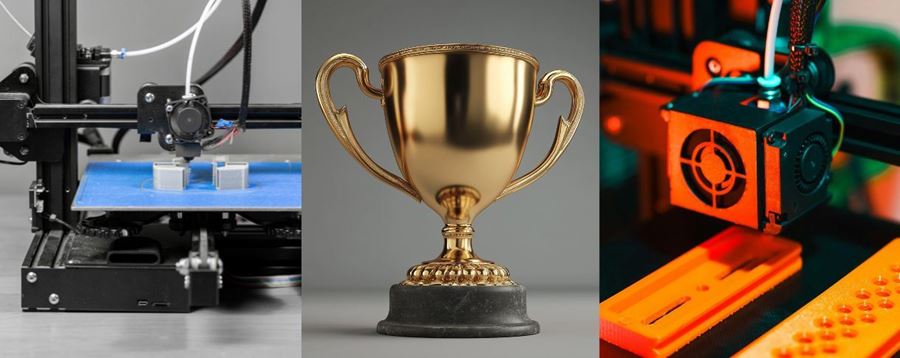
Inkerman is being asked more often for a replica trophy to be made using 3D Printing. A few years ago we would have veered away from using 3D printing but now techniques have improved and needs have changed. Ideally 3D printed trophies are used for advertising campaigns, competitions and trophy replicas for event photos . We would not recommend 3D trophies for high end Perpetual trophies as they are not robust enough to be used long term but there is certainly a time and a place for a 3D model Trophy Replica. It is important to be aware early on that if you want a good quality 3D Trophy with a metal looking finish this is not going to be a ‘cheap’ option.
The first step of creating a 3D trophy is creating a CAD file (computer-aided design) of the actual trophy. If replicating a perpetual trophy the best results will come from borrowing the original trophy and scanning it. Alternatively one can create a model where every curve, detail and dimension can be created from a picture but at Inkerman we would choose to have the original trophy to achieve all the detail.
The 3d artwork is then created to make a file ready for the printers. The next step is the actual 3D printing – this can the printing of the actual cup or the printing of a mold to use for metal casting.
The model created is then used to create a mold or guide for manufacturing, either by CNC machine or for metal casting. We prefer the metal casting using a mold. Molten metal such as aluminium, brass or stainless steel is poured in the mold and allowed to cool and harden. Once formed, the trophy is refined through cutting, welding, and polishing to sharpen details and achieve a smooth or textured finish. Alternatively the cup is printed and then finished by hand to a high standard before the metal finish is applied.
Finally, surface treatments like plating, brushing or engraving are added to enhance the appearance and durability, resulting in a solid, three-dimensional trophy that is both visually striking and long-lasting. To achieve a top quality ‘metal’ finish Inkerman use the’ chrome bombing’ technique which gives a high quality metal looking finished. This standard of finish is almost the most important stage of making a top end, recognised trophy. We can add a weighted plinth to make the trophy feel more substantial and would recommend a solid box for transporting which Inkerman can help with. A 3D printed Trophy will look the same but will not have the expensive feel of the original metal based trophy.
For a more detailed insight read on...
3D printing has moved beyond hype and experimentation. Today, it is a proven manufacturing method used to prototype, test, refine and produce functional components across a wide range of industries. At Inkerman, we use additive manufacturing as a practical engineering tool, helping clients move from concept to physical part efficiently and accurately.
Whether you are validating a new idea, refining an existing design or producing short-run components, 3D printing allows faster iteration, reduced waste and far greater design freedom than traditional methods.
What 3D printing actually offers in a manufacturing context
Also known as additive manufacturing, 3D printing builds parts layer by layer from a digital model. Unlike subtractive processes such as CNC machining—where material is removed from a solid block, additive manufacturing uses only the material required for the part.
In practice, this delivers several key advantages:
- Rapid turnaround from design to physical part
- Minimal material waste
- Complex geometries without additional tooling
- Cost efficiency for prototypes and low-volume production
- Design changes without retooling delays
These strengths make 3D printing particularly valuable during early-stage development, but increasingly viable for end-use parts as materials and print quality continue to improve.
3D printing in trophy and award design
One area where 3D printing delivers immediate value is in bespoke trophy and award design, an area where Inkerman has long-standing expertise.
Additive manufacturing allows us to prototype trophy forms, bases and components quickly, testing proportions, finishes and assembly before committing to final materials. This is particularly useful for:
- custom one-off trophies
- limited award runs
- intricate detailing that would be time-consuming to machine
- early-stage visualisation for client approval
By combining 3D printing with traditional finishing and craftsmanship, Inkerman can explore more creative forms while maintaining the quality and presence expected of presentation pieces.
Why Inkerman?
Inkerman stands out by focusing on quality, adaptability, and application. Whether you’re a startup testing a prototype or an established business looking to streamline production, Inkerman’s approach to 3D printing provides:
- Precision and consistency in printed components
- Flexible design support, enabling faster iteration
- Cost-effective solutions without compromising performance
- Scalability, from one-off prints to small-batch production
By combining modern 3D printing technologies with practical industry insight, Inkerman helps bridge the gap between ideas and reality.
How 3D printing works at Inkerman
Our approach to 3D printing focuses on repeatability, accuracy and real-world application, not just visual models.
A typical project follows these steps:
- Design review and preparation
Clients can supply their own CAD files, or work with our team to refine a design for additive manufacturing. This includes checking tolerances, wall thicknesses and stress points. - Material and process selection
We advise on the most suitable material based on strength, flexibility, heat resistance and surface finish requirements. - Printing and inspection
Parts are printed using controlled parameters to ensure consistency, followed by inspection to confirm dimensional accuracy. - Iteration or production
Designs can be adjusted quickly, or scaled into small-batch production without the need for tooling.
This allows us to support everything from one-off prototypes to repeatable, low-volume manufacturing. This approach is particularly effective for trophies and awards, where form, balance and visual impact need to be assessed physically before final production.
Materials and capabilities
Inkerman’s 3D printing capabilities are suited to functional and test-ready components rather than purely decorative parts. Depending on application, we work with materials that offer:
- Strength and impact resistance
- Dimensional stability
- Flexibility where required
- Consistent surface quality
Where 3D printing delivers the most value
3D printing is not a replacement for every manufacturing method, but it excels in specific scenarios.
It is particularly effective for:
- Prototyping and design validation
Quickly test form, fit and function before committing to tooling. - Custom or low-volume components, such as award elements, trophy bases, or bespoke decorative features
Produce parts tailored to specific requirements without the cost of moulds or dies. - Short-run production
Bridge the gap between prototype and mass manufacture. - Design experimentation
Test multiple variations quickly to optimise performance.
By removing the barriers of tooling and setup, additive manufacturing encourages smarter, more iterative development.
Sustainability and efficiency
From a sustainability perspective, 3D printing offers measurable benefits. Additive processes generate significantly less waste than traditional machining, and the ability to print parts locally reduces transportation and excess inventory.
At Inkerman, we focus on:
- material efficiency
- minimising failed prints through design optimisation
- producing only what is required, when it is required
This aligns with a more responsible approach to modern manufacturing.
When 3D printing may not be the right choice
Part of providing a reliable service is being honest about limitations. 3D printing may not be suitable if:
- very high-volume production is required
- extreme surface finishes are critical without post-processing
- material properties demand traditional methods
In these cases, we advise alternative manufacturing routes or hybrid approaches.
Working with Inkerman
Inkerman’s strength lies in combining modern manufacturing technologies with practical engineering insight. We work closely with clients to ensure additive manufacturing is used where it makes sense—technically, commercially and operationally.
If you are exploring 3D printing for a project, or want to understand whether it is the right solution, our team is happy to advise.
Email us with your questions or enquiry: [email protected] or call us on 01892 752211
3D printing is not about novelty. It is about speed, adaptability and intelligent design. Used correctly, it reduces development cycles, lowers risk and opens up new possibilities. At Inkerman, we focus on delivering those benefits, layer by layer, with precision.
For example, 3D printing can be used to prototype a complex trophy form, allowing adjustments to scale, weight distribution and detailing before final manufacture. This reduces risk, speeds up approval, and ensures the finished piece delivers the intended impact.